
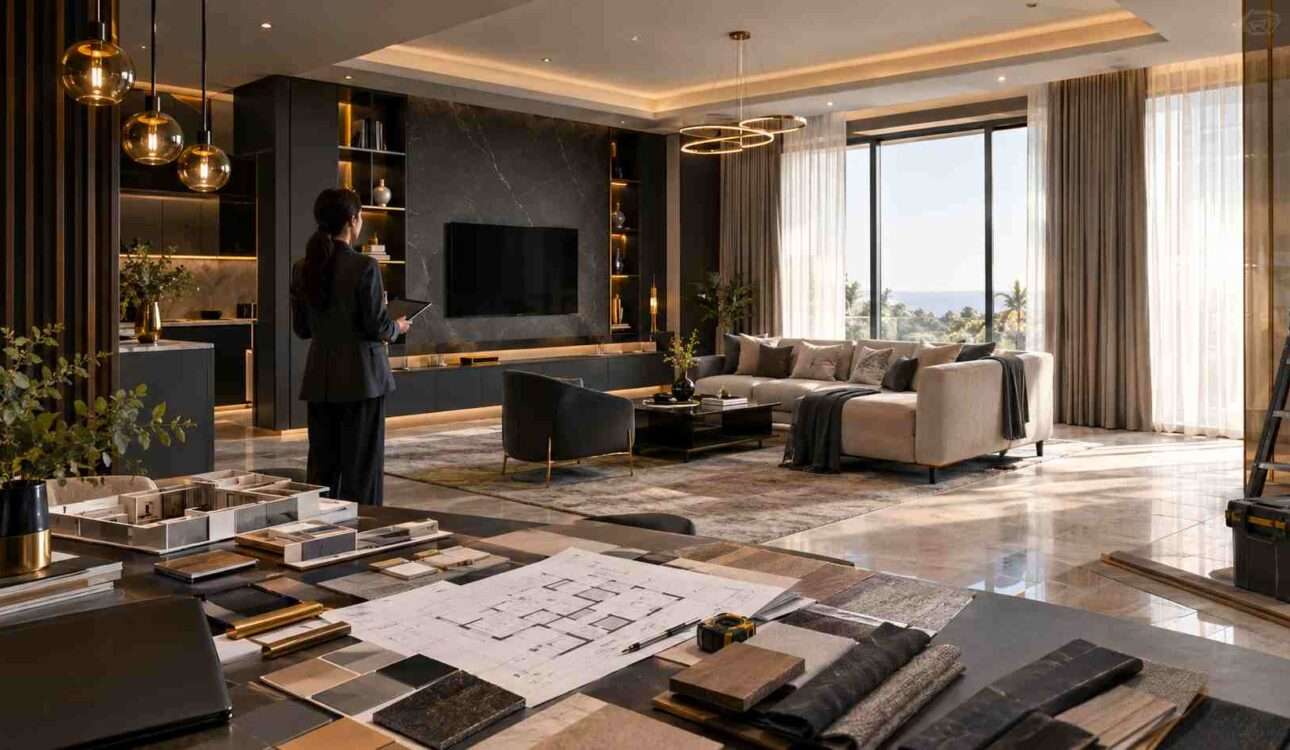
If you are wondering what is the job of an interior designer, the answer goes far beyond choosing furniture, colours, or decorative items. An interior designer plans, designs, and coordinates interior spaces to make them functional, comfortable, safe, visually appealing, and suitable for the client’s needs.
Interior designers work on homes, apartments, offices, hotels, restaurants, retail stores, studios, and other commercial spaces. Their responsibilities can include understanding client requirements, preparing layouts, selecting materials, developing concepts, creating drawings or 3D designs, coordinating with contractors, managing budgets, and supervising the execution of the project.
For people considering interior design as a career, understanding these responsibilities is important. The profession combines creativity with technical knowledge, communication, project management, and problem-solving.
What Is the Job of an Interior Designer?
The main job of an interior designer is to plan and improve interior spaces according to the client’s requirements, lifestyle, budget, and functional needs.
A professional interior designer usually works through several stages. The process starts with understanding the client’s expectations and assessing the available space. The designer then develops a concept, creates layouts, chooses materials and finishes, prepares visual presentations, coordinates with vendors or contractors, and monitors implementation.
A good interior designer balances three major areas:
- Function: The space should work well for everyday use.
- Aesthetics: The design should look attractive and reflect the desired style.
- Practicality: Materials, furniture, lighting, storage, and finishes should be suitable for the budget and project requirements.
For example, designing a family living room is not simply about selecting a beautiful sofa. The designer may need to consider movement around the room, seating capacity, lighting, television placement, storage, electrical points, colours, materials, safety, and maintenance.
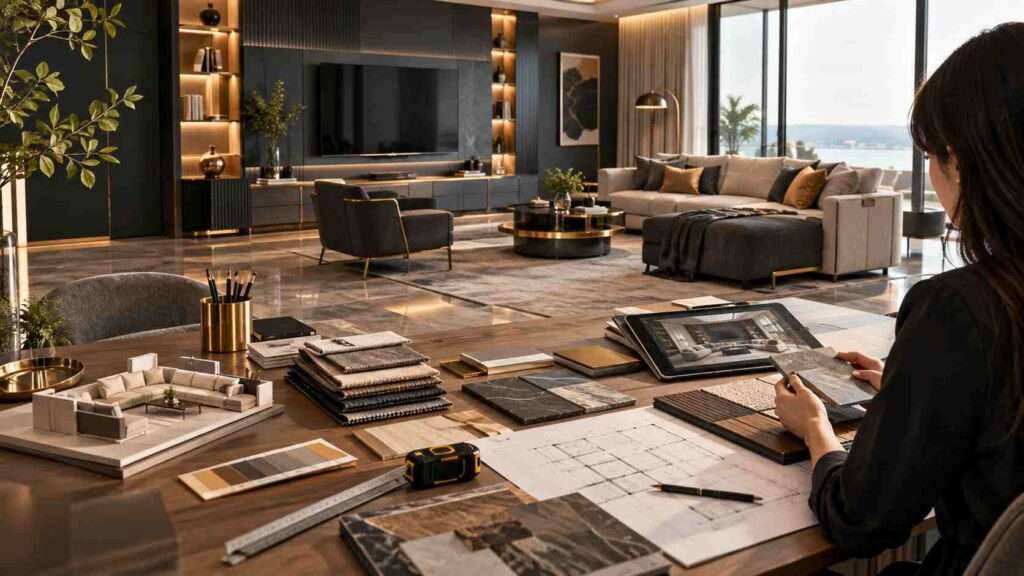
What Does an Interior Designer Do?
The exact responsibilities depend on the project, but most interior designers perform a combination of creative, technical, and management tasks.
Understanding Client Requirements
The first step is understanding what the client actually needs.
An interior designer may discuss:
- Lifestyle and daily routines
- Preferred design style
- Number of people using the space
- Storage requirements
- Colour preferences
- Furniture requirements
- Budget
- Project timeline
- Functional problems with the existing space
- Future requirements
Good communication at this stage helps prevent misunderstandings later.
Measuring and Analysing the Space
Before developing a design, the designer needs accurate information about the space.
This can include:
- Room dimensions
- Wall locations
- Doors and windows
- Ceiling height
- Electrical points
- Plumbing locations
- Structural elements
- Existing furniture
- Natural lighting
- Ventilation
- Circulation paths
Accurate measurements are essential because even a small mistake can create problems during installation.
Creating Space Plans and Layouts
Space planning is one of the most important parts of an interior designer’s job.
The designer determines where different elements should be positioned so that the space remains comfortable and functional.
For example, a living room layout may need to account for:
- Sofa placement
- Chairs
- Coffee table
- Television
- Storage
- Walking paths
- Lighting
- Doors and windows
A well-planned layout can make a small room feel more spacious and make a large room feel more balanced.
Developing the Interior Design Concept
After understanding the space and requirements, the designer develops a design concept.
This may include:
- Modern interiors
- Minimalist interiors
- Contemporary interiors
- Traditional interiors
- Luxury interiors
- Industrial interiors
- Scandinavian-inspired interiors
- Eclectic interiors
The concept provides a visual direction for the entire project.
Selecting Colours, Materials and Finishes
Interior designers also choose materials and finishes that match the concept and practical requirements.
These can include:
- Paint colours
- Flooring
- Tiles
- Wallpaper
- Wood finishes
- Laminates
- Countertops
- Fabrics
- Curtains
- Glass
- Metal finishes
- Decorative surfaces
Material selection should consider appearance, durability, maintenance, availability, and budget.
Interior Designer Skills You Need
Successful interior designers need more than artistic creativity. The profession requires a combination of design, technical, business, and communication skills.
Creativity and Visual Thinking
Creativity helps designers develop unique ideas and attractive spaces.
However, professional creativity is not simply about making something unusual. Designers need to create solutions that work for the client and the available space.
Space Planning Skills
Understanding proportions, dimensions, circulation, furniture placement, and spatial relationships is essential.
A designer should be able to look at an empty room and understand how it can be organised efficiently.
Knowledge of Colours and Materials
Interior designers should understand how colours, textures, patterns, materials, and finishes work together.
They should also know how different materials perform in real-world conditions.
Technical Drawing and Design Software
Modern interior design often involves digital tools.
Depending on the job, designers may work with:
- AutoCAD
- SketchUp
- 3D modelling software
- Rendering software
- Photoshop
- Canva
- Other architectural or interior design applications
The exact software requirements vary by employer and project.
Communication Skills
Interior designers regularly communicate with clients, contractors, carpenters, electricians, plumbers, architects, suppliers, and other professionals.
Clear communication helps keep the project organised and reduces errors.
Budgeting and Cost Management
A designer must understand the relationship between design choices and project costs.
For example, changing a particular material, furniture specification, or finish can significantly affect the overall budget.
Project Management
Interior design projects involve deadlines, suppliers, workers, materials, measurements, installations, and multiple stages.
Project management skills help ensure that the work progresses smoothly.
Step-by-Step Interior Design Process
The interior design process can vary between designers and projects, but a typical workflow looks like this:
Step 1: Initial consultation
The designer meets the client and discusses requirements, preferences, lifestyle, budget, and expectations.
Step 2: Site visit and measurements
The designer evaluates the existing space and records dimensions and important site information.
Step 3: Design brief
The requirements are converted into a structured design brief.
Step 4: Concept development
The designer creates the overall visual direction, including style, colours, materials, and atmosphere.
Step 5: Space planning
Furniture, storage, circulation, lighting, and functional areas are planned.
Step 6: Drawings and 3D visualisation
Depending on the project, the designer prepares technical drawings, elevations, mood boards, or 3D visualisations.
Step 7: Material and product selection
Furniture, fixtures, finishes, lighting, fabrics, and other products are shortlisted.
Step 8: Budget and quotation
Costs are estimated and the project scope is finalised.
Step 9: Execution and coordination
The designer coordinates with contractors, suppliers, installers, and other professionals.
Step 10: Final inspection
The completed work is reviewed to identify finishing issues and ensure that the design has been implemented according to the agreed requirements.

Interior Designer vs Interior Decorator
Interior designers and interior decorators are sometimes used interchangeably, but their roles can be different.
| Interior Designer | Interior Decorator |
|---|---|
| Focuses on space planning and interior functionality | Focuses mainly on appearance and decoration |
| May prepare layouts and technical drawings | Usually works with existing layouts |
| May coordinate construction or renovation work | Usually focuses on furnishings and finishes |
| Considers spatial requirements | Concentrates strongly on visual styling |
| Can work on renovation projects | Often works on styling and finishing |
| May coordinate multiple trades | Usually has a narrower project scope |
The exact responsibilities can overlap, particularly in smaller residential projects.
Where Do Interior Designers Work?
Interior designers can work across many sectors.
Residential Interior Design
Residential designers work on:
- Apartments
- Villas
- Independent houses
- Bedrooms
- Living rooms
- Kitchens
- Bathrooms
- Home offices
Commercial Interior Design
Commercial projects can include:
- Offices
- Retail stores
- Restaurants
- Cafés
- Hotels
- Clinics
- Salons
- Showrooms
Commercial interiors often require stronger attention to branding, customer experience, workflow, and business requirements.
Freelance Interior Design
Some designers work independently and provide services directly to clients.
Freelancers may offer:
- Complete interior design
- Room design
- 3D visualisation
- Space planning
- Design consultation
- Furniture selection
- Colour consultation
- Renovation coordination
Freelancing can provide flexibility, but it also requires marketing, client acquisition, budgeting, communication, and business management skills.
Interior Designer Salary: How Much Can You Earn?
One of the most common questions from people considering this profession is interior designer salary.
There is no single salary figure because earnings vary based on experience, location, education, software skills, employer, project type, portfolio, and whether the designer works as an employee or independently.
| Career Stage | Typical Earning Factors |
|---|---|
| Entry-level designer | Education, basic software skills, internship and portfolio |
| Junior designer | Project experience and technical skills |
| Mid-level designer | Project responsibility, client handling and specialised expertise |
| Senior designer | Leadership, design expertise and project management |
| Freelance designer | Number and value of projects, reputation and client network |
| Design business owner | Project volume, pricing, team size and business operations |
Instead of focusing only on a salary number, aspiring designers should develop skills that increase their professional value.
These include:
- Strong portfolio
- CAD and 3D skills
- Client communication
- Project management
- Material knowledge
- Vendor coordination
- Cost estimation
- Industry experience
- Personal branding
What Qualifications Are Needed to Become an Interior Designer?
Educational requirements can vary depending on the employer and country.
Students may consider courses or degrees related to:
- Interior design
- Interior architecture
- Architecture
- Fine arts
- Design
- Space planning
However, education is only one part of becoming employable. Practical experience and a strong portfolio are extremely important.
An aspiring designer should try to build projects that demonstrate:
- Floor planning
- Furniture layouts
- Colour schemes
- Mood boards
- Material selections
- 3D visualisations
- Before-and-after concepts
- Residential or commercial design ideas

Interior Designer Daily Responsibilities Checklist
A typical day can include several different activities.
Client-related tasks
- Attend client meetings
- Understand requirements
- Discuss design concepts
- Present proposals
- Collect feedback
- Explain material options
Design tasks
- Create layouts
- Modify floor plans
- Develop mood boards
- Prepare 3D concepts
- Select colours
- Choose materials
- Review furniture placement
Project tasks
- Coordinate with contractors
- Contact suppliers
- Check material availability
- Review site progress
- Resolve design-related problems
- Track project timelines
Business tasks
- Prepare quotations
- Manage project budgets
- Create proposals
- Follow up with leads
- Maintain portfolios
- Market design services
Important Things to Know Before Choosing Interior Design as a Career
Interior design can be a rewarding career, but it is not only about creativity.
Before entering the profession, understand that you may need to:
- Work with deadlines
- Handle client revisions
- Visit project sites
- Coordinate with different professionals
- Solve unexpected problems
- Work within budgets
- Learn design software
- Understand construction materials
- Keep learning new design trends
The ability to combine creativity with practical problem-solving is one of the most valuable qualities in this profession.
How to Become a Successful Interior Designer
If you want to build a career in interior design, focus on practical development rather than relying only on qualifications.
Build a Strong Portfolio
Your portfolio should demonstrate what you can actually design.
Include different types of projects and clearly show the thinking behind each concept.
Learn Industry Software
Become comfortable with the software commonly used in your target job market.
Gain Practical Experience
Internships, junior roles, freelance projects, and assisting experienced designers can help you understand how real projects work.
Develop Client Communication Skills
A designer must be able to explain ideas clearly to people who may not understand technical design terminology.
Understand Materials
Visit material suppliers and showrooms when possible. Seeing materials in person can teach you things that software cannot.
Learn Basic Project Management
Understanding timelines, budgets, suppliers, contractors, and installations can make you a more valuable designer.
Interior Design Career Checklist
Before applying for an interior design job or starting freelance work, check whether you have developed these areas:
- Basic design principles
- Space planning
- Colour theory
- Material knowledge
- Furniture planning
- CAD or design software
- 3D visualisation
- Portfolio
- Communication skills
- Budget awareness
- Project coordination
- Client presentation skills
Final Thoughts
Understanding what is the job of an interior designer helps explain why the profession involves much more than decoration. Interior designers combine creativity, technical knowledge, planning, communication, and project coordination to transform spaces into practical and attractive environments.
For anyone considering interior design as a career, the best approach is to develop a strong combination of interior designer skills, practical experience, software knowledge, and portfolio quality. With continuous learning and real project exposure, designers can build careers across residential, commercial, hospitality, retail, freelance, and entrepreneurial opportunities.
The job of an interior designer is to plan and develop functional, safe, comfortable, and visually appealing interior spaces. Responsibilities may include space planning, design concepts, material selection, drawings, budgeting, client communication, and project coordination.
Important interior designer skills include creativity, space planning, colour knowledge, material selection, technical drawing, design software, communication, budgeting, problem-solving, and project management.
Interior design can be a good career for people who enjoy creativity, design, problem-solving, and working with clients. Career opportunities exist in residential design, commercial design, hospitality, retail, architecture and design firms, and freelancing.
Interior designer salary varies depending on experience, location, employer, qualifications, portfolio, skills, and work type. Freelancers and business owners may earn based on project fees rather than a fixed salary.
Yes. Interior designers can work independently and offer services such as space planning, room design, 3D visualisation, material selection, consultations, and complete interior projects. Freelancing also requires strong communication, marketing, pricing, and project-management skills.