Starting an interior design business can be an exciting way to turn creativity, design skills, and an understanding of spaces into a profitable career. Whether you want to work with homeowners, offices, restaurants, or property developers, the interior design industry offers opportunities for both beginners and experienced designers.
The good news is that you do not necessarily need a large office, expensive equipment, or a huge team to get started. With the right niche, portfolio, pricing strategy, marketing plan, and client process, you can build an interior design business gradually.
This guide explains how to start an interior design business, including how to begin with limited money, find your first clients, build a portfolio, set prices, market your services, and grow your business.
What Do You Need to Start an Interior Design Business?
Before taking your first project, you need a clear business foundation. Your exact requirements will depend on your location, services, and business structure, but most new interior design businesses need:
- A clear interior design niche
- Basic design skills and industry knowledge
- A professional portfolio
- Business name and branding
- A method for communicating with clients
- Design software or suitable tools
- A pricing and payment structure
- A basic contract or agreement
- A website or professional online presence
- Social media profiles
- A system for finding and managing leads
- Knowledge of applicable local business and professional requirements
You do not have to build everything at once. Start with the essentials and improve your systems as your client base grows.

Step 1: Choose Your Interior Design Niche
One of the first decisions is choosing what type of interior design work you want to offer.
Trying to serve everyone can make your marketing less effective. A defined niche helps potential clients quickly understand what you do.
Possible niches include:
- Residential interior design
- Luxury home interiors
- Apartment interiors
- Modular kitchen design
- Bedroom and living room design
- Office interiors
- Commercial interiors
- Restaurant and café interiors
- Retail store design
- Rental property interiors
- Home renovation consulting
- Space planning
- Interior styling
- 3D visualization and design consultation
For example, instead of saying:
“I provide all types of interior design services.”
you could position your business as:
“We specialize in modern residential interiors, including living rooms, bedrooms, modular kitchens, and complete home design.”
A focused offer can make it easier to create relevant content, attract the right audience, and develop expertise.
Step 2: Decide What Services You Will Offer
Your interior design business can provide one service or a combination of services.
Common Interior Design Services
| Service | What It Includes |
|---|---|
| Design Consultation | Advice about layouts, colours, furniture and materials |
| Space Planning | Planning furniture placement and room functionality |
| 2D Design | Floor plans and design layouts |
| 3D Visualization | Realistic or conceptual 3D views |
| Material Selection | Choosing flooring, finishes, fabrics and other materials |
| Modular Kitchen Design | Kitchen layouts, storage and cabinet planning |
| Residential Design | Complete or partial home interior planning |
| Commercial Design | Offices, shops, cafés and other business spaces |
| Project Coordination | Helping coordinate vendors and implementation |
When starting out, you can offer a smaller number of services rather than trying to manage every part of a project.
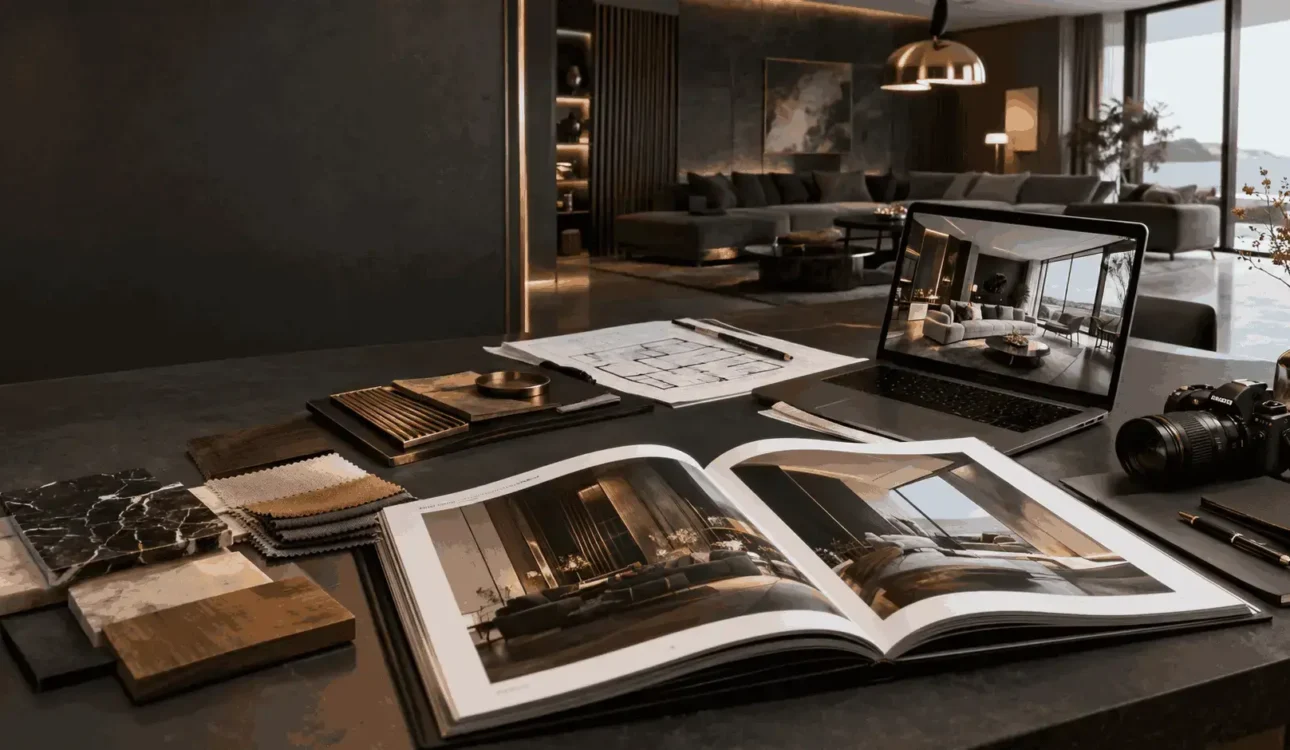
Step 3: Build a Professional Portfolio
A portfolio is one of the most important marketing assets for an interior designer.
Potential clients want to see what you can create before they trust you with their space.
If you have completed projects, photograph them professionally and organize them into categories.
If you are a beginner without client projects, you can still create a portfolio.
How to Build a Portfolio Without Many Clients
Create concept projects for different room types, such as:
- Modern living room
- Minimalist bedroom
- Contemporary kitchen
- Compact apartment
- Home office
- Luxury master bedroom
- Small-space interior
- Modern commercial office
Clearly label concept work as conceptual or sample design rather than presenting it as a completed client project.
Your portfolio should demonstrate:
- Design thinking
- Space planning
- Colour selection
- Material combinations
- Furniture selection
- Lighting concepts
- Attention to detail
- Different design styles
A smaller portfolio with excellent work is usually more useful than a large portfolio filled with inconsistent designs.
Step 4: Learn How to Price Your Services
Pricing is one of the most important parts of starting an interior design business.
There is no single price that works for every designer. Your pricing can depend on project size, location, experience, complexity, deliverables, and the amount of project management involved.
Common pricing models include:
- Fixed project fee
- Per-square-foot pricing
- Hourly consultation
- Percentage-based pricing
- Package pricing
Interior Design Pricing Models Compared
| Pricing Model | Best For | Main Advantage |
|---|---|---|
| Fixed Fee | Clearly defined projects | Easy for clients to understand |
| Per Square Foot | Larger spaces | Scales with project size |
| Hourly | Consultations | Flexible for small requirements |
| Percentage | Large projects | Reflects project value |
| Package | Beginners and standardized services | Easy to market |
Before quoting a price, calculate the time, resources, software, travel, communication, revisions, and other expenses involved.
Do not price a project only according to what competitors charge. Your pricing should also allow your business to remain sustainable.
Step 5: Create a Simple Client Process
A professional client process can make a small interior design business look much more established.
A simple workflow could be:
Enquiry → Consultation → Requirement Analysis → Proposal → Agreement → Design → Revisions → Approval → Implementation → Final Handover
What to Discuss During the First Consultation
Ask the client about:
- Type of property
- Number of rooms
- Design preferences
- Functional requirements
- Approximate budget
- Expected timeline
- Existing furniture
- Preferred materials
- Storage requirements
- Lifestyle requirements
- Implementation expectations
Document important requirements instead of relying only on memory.
Step 6: Create a Professional Brand
Your brand does not need to be expensive when you are starting.
Focus on consistency.
Create:
- A memorable business name
- Simple logo
- Professional colour palette
- Consistent typography
- Portfolio style
- Professional email address
- Social media identity
Your visual identity should match the type of clients you want to attract.
For example, a luxury interior design business may use a refined and minimal visual style, while a family-focused residential designer may choose a warmer and more approachable identity.
Step 7: Build a Website for Your Interior Design Business
A website gives potential clients a place to understand your services and evaluate your expertise.
A basic interior design website can include:
Home Page
Explain who you are, what you offer, your design approach, and the type of clients you serve.
About Page
Introduce your experience, design philosophy, and approach to projects.
Services Page
Explain your main services and what clients can expect.
Portfolio Page
Show your strongest projects and design concepts.
Contact Page
Make it easy for potential clients to enquire.
Blog
Publish useful content related to interior design, such as:
- Living room design ideas
- Modular kitchen trends
- Small apartment design
- Bedroom colour ideas
- Interior design costs
- Space-saving furniture
- Lighting ideas
- Home renovation tips
A blog can help your website attract people who are researching interior design before they are ready to contact a designer.
Step 8: Focus on Local SEO
For an interior designer, local visibility can be extremely valuable because many clients search for designers in their city or area.
For example, people may search for:
- Interior designers near me
- Interior designers in [city]
- Home interior designers in [city]
- Best interior designers in [city]
- Modular kitchen designers in [city]
Create and optimize your Google Business Profile where eligible, maintain accurate business information, add quality project photographs, and encourage genuine customer reviews.
Your website should also naturally mention the areas you serve.
Local SEO Checklist
- Create/claim your Google Business Profile
- Keep business information accurate
- Add high-quality project photographs
- Collect genuine customer reviews
- Add your service areas where appropriate
- Create useful local website content
- Build relevant local citations
- Maintain consistent business information
- Add project-related content regularly
- Monitor your local search visibility
Avoid adding city names unnaturally to every sentence. Local SEO works best when location information is useful and natural.
Step 9: Use Social Media to Showcase Your Work
Interior design is highly visual, making platforms such as Instagram, Facebook, Pinterest, and YouTube useful for showcasing projects and ideas.
Instead of only posting finished rooms, create content that demonstrates your expertise.
Content Ideas
- Before-and-after transformations
- 3D design concepts
- Design mistakes to avoid
- Colour combinations
- Small-space solutions
- Kitchen organization ideas
- Lighting tips
- Material comparisons
- Furniture selection tips
- Behind-the-scenes project content
- Client project stories
- Design process videos
For every post, think about the question:
“Does this help a potential client make a better design decision?”
Educational content can build trust before someone contacts your business.

How to Start an Interior Design Business Without Money
You can start an interior design business with limited money by keeping your initial expenses under control.
The goal is not to avoid every expense forever. Instead, prioritize spending on activities that directly help you build credibility or generate clients.
Start With What You Already Have
You may initially be able to use:
- Your existing computer
- Free or affordable design tools
- Free social media platforms
- A simple website
- Existing design projects
- Sample or conceptual portfolio projects
- Networking
- Organic SEO
- Referrals
Low-Cost Starting Strategy
Step 1: Choose a niche.
Step 2: Create 5–10 strong portfolio projects.
Step 3: Build a simple website.
Step 4: Create professional social media profiles.
Step 5: Start publishing useful design content.
Step 6: Network with contractors, architects, property professionals and suppliers.
Step 7: Ask satisfied early clients for genuine reviews and referrals.
Step 8: Reinvest part of your income into better photography, software, marketing and business systems.
You do not need a premium office on day one. A professional remote or consultation-based setup can be enough for many early-stage designers, depending on the services being offered.
How to Get Your First Interior Design Clients
Getting the first client is often harder than completing the actual design work.
Start with people and businesses who already have a reason to interact with property owners.
Potential referral sources include:
- Contractors
- Architects
- Real estate professionals
- Furniture stores
- Kitchen suppliers
- Home renovation companies
- Property managers
- Builders
- Local business owners
You can also use social media and local search to attract direct enquiries.
A Simple Client Acquisition Formula
Useful Content + Strong Portfolio + Local Visibility + Networking + Referrals = Consistent Lead Opportunities
Do not expect every person who sees your content to become a client. The objective is to consistently build awareness and trust.
Interior Design Business Owner Salary: What to Expect
Many people researching interior design business owner salary expect to find one fixed figure. In reality, business-owner income can vary considerably.
An owner’s earnings depend on factors such as:
- Number of projects
- Average project value
- Profit margin
- Operating expenses
- Pricing model
- Location
- Experience
- Type of clients
- Team size
- Recurring referral business
- Ability to manage multiple projects
A business generating high revenue does not automatically mean the owner takes home a high income. Expenses, salaries, software, marketing, transportation, rent, taxes, subcontractors, and other costs affect profitability.
Therefore, when planning your business, focus on profitability and cash flow, not just revenue.
Common Mistakes New Interior Designers Should Avoid
Starting a business is easier when you understand the mistakes that can create unnecessary problems.
1. Working Without Clear Agreements
Define deliverables, revisions, timelines, fees, payment terms, and responsibilities before beginning substantial work.
2. Underpricing Every Project
Very low prices can make it difficult to deliver quality work profitably.
3. Accepting Every Type of Client
A clear target market makes your marketing more focused.
4. Ignoring Marketing
Great design work does not automatically guarantee visibility.
5. Having a Weak Portfolio
Your portfolio should show your strongest capabilities rather than simply containing as many images as possible.
6. Promising Unrealistic Deadlines
Always consider revisions, procurement, contractor coordination, and unexpected delays.
7. Failing to Track Expenses
Know where your money is going from the beginning.
Beginner Checklist for Starting an Interior Design Business
Use this checklist to make sure your foundation is ready:
- Choose your design niche
- Define your ideal client
- Decide your core services
- Create a professional business name
- Develop your visual identity
- Build a portfolio
- Establish pricing
- Create a client agreement
- Set up a professional website
- Create social media profiles
- Set up local search presence where eligible
- Develop a content strategy
- Build industry connections
- Create a lead management system
- Track expenses and revenue
- Collect genuine client reviews
- Improve your services based on feedback
A 90-Day Plan for Starting Your Interior Design Business
You do not have to build the entire business in one week. A structured 90-day plan can make the process easier.
| Period | Main Goal | Key Activities |
|---|---|---|
| Days 1–30 | Foundation | Choose niche, services, branding and pricing |
| Days 31–60 | Visibility | Build website, portfolio and social profiles |
| Days 61–90 | Client Acquisition | Networking, content, SEO, referrals and enquiries |
During the first month, focus primarily on building the business foundation.
During the second month, make your business visible online.
During the third month, concentrate on generating conversations with potential clients.
The process does not end after 90 days. Continue improving your portfolio, marketing, client experience, and systems.
Final Thoughts
Learning how to start an interior design business is not only about having creative design skills. A successful business also requires planning, communication, pricing, marketing, client management, and consistent delivery.
You can start small without investing heavily in an office or large team. Choose a clear niche, create a strong portfolio, establish a professional client process, build an online presence, and gradually develop your reputation.
Most importantly, focus on creating real value for clients. A beautiful design is important, but clients also want functional spaces, clear communication, realistic budgets, reliable timelines, and a smooth experience.
As your experience and client base grow, you can reinvest in your business, expand your services, build a team, and take on larger projects.
The amount varies depending on your location, services, equipment, software, marketing strategy, and business setup. You can start relatively lean by working remotely, using existing equipment, creating a digital portfolio, and focusing on organic marketing before making larger investments.
Yes, you can begin with a low-cost model by using existing resources, creating conceptual portfolio projects, networking, using social media, developing organic SEO, and starting with consultation or smaller design services. However, some business and professional expenses may still be necessary depending on your location and activities.
Start with your personal and professional network, local businesses, contractors, architects, real estate professionals, suppliers, social media, referrals, and local search. A strong portfolio and clear service offering make it easier for potential clients to understand what you can provide.
An interior design business can be profitable, but profitability depends on pricing, project volume, expenses, operational efficiency, client type, and business management. Revenue alone does not determine how much the owner earns.
Include your strongest work and demonstrate different aspects of your capabilities, such as space planning, colour schemes, furniture selection, lighting, materials, 2D layouts, and 3D visualizations. If you use conceptual projects, identify them clearly as concept work.